Pages

.

Right Medication

I am finally, finally, finally feeling like the demon of depression is lifting and it is due to the right medication.  I know that anti-depressants are not the "be all and end all" to depression -- I am also seeing a therapist and trying to eat right, exercise right, meditate, etc.  But really, truly, for me, the right antidepressants make all the rest of it work and "stick." 

It has been a hard struggle from the time people suggested I try antidepressants and I became furious, to admitting I needed something, about four years ago.  Well I feel like I've tried them all - prozac, zoloft, wellbutrin, paxil, lexapro, effexor, and others.  Some didn't work, some I didn't like the side effects.  But finally I found one that works.  I know medication won't work for everyone but it did work for me.  The key was seeing a psychiatrist I trusted ... my regular physicians didn't know the medications that well and were leery to prescribe some of them.  The other key was reminding myself, it was not "me" it was a disease or a condition that could be treated just like anything else. 

cheers,

Rachel
reade more... Résuméabuiyad

Exercise & Nutrition

I'm a 41 year-old unemployed engineer, finally finishing a Bachelor's degree. I have been depressed for at least 25 years, since I severely injured my back at age 15. I was raised in a very abusive family and was not given any medical treatment, so I lived in chronic pain until age 25.
 
I was finally able to get medical care for my back when I started working in the U.S. defense industry. However, my spinal pain was then replaced by neurological trauma. I was tortured for over two years by the U.S.  government, who used infrasound and modulated ultrasound (and possibly other things)to experiment on my mind and nervous system. Several attempts were made to kill me using some especially horrifying psychological techniques. In the last 9 years since getting out of the defense industry, I have been regularily harrassed by the local police and sheriff's departments, anomg other law enforcement agencies. I have told some people about my experiences, but I am either disbelieved or laughed at and told that I "deserved it". I have not been able to get any help from either psychologists or psychiatrists.
 
So, what keeps me alive? Hard exercise and good nutrition. I find if I do enough aerobic exercise each day, I can eventually feel well enough to endure another day. I don't believe there is any God or after-life. That helps me realize the importance of this life, the only eternity any of us will ever have, and how important it is to take every opportunity to live when we are able. Never give up on yourself! Never stop fighting for the life you deserve! Do what you can on the bad days, and do as much as you can on the good days. Above all else, believe in your right to exist and your intrinsic value. Only truly human beings give any meaning to this universe - that's how important you are! Good luck to each of you.
Paul
reade more... Résuméabuiyad

Life Is A Beautiful Thing

I have been and seen so much. I use what I have had in the past to overcome
what I have now. I use expieriences to get thorough what seems so hopeless
at times. I journal thoughts and moods that only stay in that journal entry.
I look forward to the next minute if need be. I look forward to what I have
accopmlised as a woman. In times of relaps I force my self to remember only
what makes me feel worth the while to come out of what only brings me down.
Face reality instead of living in a fantasy world. Keep a picture of my son
with me and when i feel bad look at it and remember what thinks the world of
me when I feel like I aint shit.

I have overcome some serious times of depression in my life. When the entire
being around me but my journal and one friend and a chaplin turned their
back on me for who I was as a person because of a wrongful action I'd
endulged in. I was in serious hopeless mode. I walked around with only my
feet and the few feet ahead of me to look at. It was only the meer thoght of
my son and his outlook on his own mother that gave me the strength to pick
up the pieces and move on. I held my head up high I started to smile and
things turned around. Everything that seemed so gone did a complete 180
infront of me day by day. I only kept those very things with me to live each
day and I got a lot of respect and I grew up a little after that.

I am 22 years old and a mother of a beautiful baby boy named, Gavin Dax
Gilbert. The one thing in my life that I can honesly truly be proud of and
commend my self time and time againe for. I believe that everything in life
happens for a reason and with that I am able to depict things in life that I
never was able to prior to some of the things I have over came since I've
had my son. I grew up! I faced my fears and lived through them rather than
push it away for a later relaps and worse off depression that I'd started
out with.

Life is a beautiful thing and it has so much for you to just make it even
through the day that we always seem to dismiss at a time of a depressed
state of mind. It always at its worst before it gets better.

Evelyn

reade more... Résuméabuiyad

It's That Time of Year Again: Seasonal Affective Disorder

by, Deborah Serani, Psy.D.
~~~~~~~~~~~~~

Question: What is seasonal affective disorder?
Answer: Seasonal Affective Disorder (SAD) is a pattern of significant depressive symptoms that occur and then disappear with the changing of the seasons. SAD has also been called "Winter Depression" or "Winter Blues". The reason for these names is that SAD occurs when days get shorter around November and lasting until Spring.

Question: What's the difference between seasonal affective disorder and other forms of depression?
Answer: SAD is similar to other major depressions in its severity and symptoms; however, it occurs seasonally usually starting in the fall and lasting until early spring. This disorder is cyclical. SAD patients also tend to sleep and eat more compared to patients with other types of clinical depression — usually, depression patients have insomnia and loss of appetite.

Question: How many people are affected by this disorder each year?
Answer: SAD affects millions of individuals worldwide. The illness is more common in higher latitudes, that is locations farther north or south of the equator, because the timeline of darkness is longer.

Question: What are the symtpoms of SAD?
Answer: Symptoms include many of the same symptoms of depression: sadness, anxiety, lost interest in usual activities, withdrawal from social activities and an inability to concentrate. The difference though, is that these symptoms resolve each Spring and tend to occur again in late Fall.

Question: What is the cause of Seasonal Affective Disorder?
Answer: Melatonin, a sleep-related hormone secreted by the pineal gland in the brain, has been linked to SAD. This hormone, which may cause symptoms of depression, is produced at increased levels in the dark. Therefore, when the days are shorter and darker the production of this hormone increases.

Question: What kind of treatments are available?
Answer: Phototherapy or bright light therapy has been shown to suppress the brain’s secretion of melatonin. Although, there have been no research findings to definitely link this therapy with an antidepressant effect, many people respond to this treatment. The device most often used today is a bank of white fluorescent lights on a metal reflector and shield with a plastic screen.

For mild symptoms, spending time outdoors during the day or arranging homes and workplaces to receive more sunlight may be helpful. One study found that an hour’s walk in winter sunlight was as effective as two and a half hours under bright artificial light.

If phototherapy doesn’t work, an antidepressant drug may prove effective in reducing or eliminating SAD symptoms.

Daily exercise has been shown to be helpful, particularly when done outdoors. For those who tend to crave sweets during the winter, eating a balanced diet may help stave off SAD.

Question: How Do I Seek Treatment for SAD?
Answer: If you have noticed a pattern to your depressive symptoms, make an appointment with your physician and bring this to his or her attention. Medical tests and exams should be up to date to rule out any other reason for depressive symptoms. Thereafter, a consult with a psychologist, social woker, psychiatrist or psychopharmacologist so that together you can formulate a treatment plan with light therapy, medication, talk therapy or a combination of them.

Resources
Seasonal Affective Disorder Association: http://www.sada.org.uk/

Society for Light Treatment :www.websciences.org/sltbr

The Circadian Lighting Association: www.claorg.org
reade more... Résuméabuiyad

Virtual Reality Therapy: The New Horizon


I just attended a conference on Virtual Reality Therapy... a treatment that uses custom virtual environments that have been carefully designed to address a particular anxiety or phobia. Being a lover-of-all-things-new and an member of the geek squad, I could barely hold my enthusiasm for this promising clinical intervention. Right now, Virtual Reality Therapy is a small niche, where several research universities and forward thinking practitioners are using this exposure therapy for anxiety and phobic disorders[1].

The treatment involves exposing a patient to a virtual environment containing the feared situation rather than taking the patient into the actual environment or having the patient imagine the anxiety promoting situation. The patient puts on the headgear, and the virtual environment is controlled by the therapist through a computer keyboard. The treatment sessions allow the therapist and the patient full control of the exposure to the feared situations. Virtual reality exposure treatment allows the therapist to manipulate situations to best suit the individual patient during a standard therapy hour (usually 45-50 minutes) and within the confines of the therapist's office [2].

Here are actual Virtual Reality Therapy Scenes...

Fear of Flying
(Aviophobia)


Fear of Spiders
(Arachnaphobia)


Fear of Heights
(Acrophobia)


Fear of Thunder and Lightning Storms
(Astraphobia)


Fear of Public Speaking
(Glossophobia)


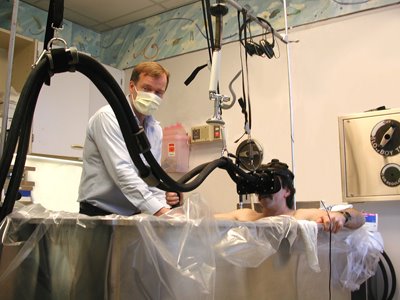
Virtual Reality Therapy does not only address psychological issues. VRT has also been used in the hospital and medical settings.


Dr. Hunter S. Hoffmann, a pioneer in Virtual Reality Therapy, recently completed a study of burn patients using headgear that allowed patients to enter a pleasant virtual reality environment as they underwent painful wound care.

Although this line of research is just beginning (with funding from NIH, the Paul Allen Foundation), results indicate a significant decrease in pain that patients experience[3].

And researchers at Emory University School of Medicine, Virtually Better Incorporated, and The National Institutes of Health (NIH), are testing the use of Virtual Reality Therapy to find out if it can help people with lower back pain learn how to relax, breath properly, and manage their pain [4].


Footnotes

[1]Schare, M. (2005) Virtual Reality Psychotherapy: Anxiety Treatment and Beyond. Nassau County Psychological Association Annual Conference, Garden City, New York, 10/28/2005.

[2] Virtually Better Website: http://www.virtuallybetter.com/

[3] Scientific American Hoffman, H. (2004) Virtual Reality Therapy accessed @ http://www.sciam.com/print_version.cfm?articleID=000CDC34-D80E-10FA-89FB83414B7F0000

[4] Emory University: http://www.whsc.emory.edu/pressreleases2.cfm?announcementidseq=2539


reade more... Résuméabuiyad

The Ghost Network


If you live in the United States, has this ever happened to you?

You call a psychologist, social worker of psychiatrist who is "on your plan" only to find out that they "are not" on your plan?"

Have you found yourself feeling disgusted and exhausted from this experience, and deciding not to go further with finding a therapist?

Consider yourself haunted... By a Ghost Network.

A Ghost Network, also called a Phantom Network, is a collective list of doctors and specialists that your insurer insists are contracted providers for your medical or mental health needs. However, many of these identified individuals are not members of the network [1].

I have been part of a Ghost Network, haunting the managed care company of Group Health Insurance, for almost a decade. I do not participate with them, have signed no contract with them - - yet, year after year, they have my name in their panel of specialists. Many potential patients call my office thinking that I am in their plan, only to discover I am not. I do not participate with *any* managed care companies because I think they are unethical in the way they regulate health care, but that is for another post.

When the person calling discovers that I am not in their network, I always help them try to find a good therapist... and I always educate them about the Ghost Network they have found themselves in. I tell them to inform their employer and colleagues about the situation so that the next time a choice for a different insurance coverage comes up, a change can occur. Managed Care companies sell their services by "showing off" the list of specialists they have in their network. The Managed Care organizations that use a Ghost Network are engaging in fraudulent behavior and bad faith, making promises they cannot deliver. Before my phone call ends, I tell them to call GHI to share their dismay as well. I am not the only ghost haunting GHI or other insurance and managed care organizations. This is a rampant problem in the United States!

The real issue here is the method behind the madness...Insurance companies and managed care companies want you, the person looking for help, to get frustrated. They want you to fatigue and get disgusted in the hopes that you will chuck all your plans for intervention or treatment. Yes, Ghost Networks are about making money.

Ghost and Phantom Networks are very difficult with which to get removed. I have written, faxed and called many, many times over the years, only to learn that I am still haunting and lurking in spirit. There are even deceased practitioners listed in Phantom Networks. I wonder how they sign their yearly contracts?

Ghost Networks are widespread throughout the United States says Dr. Lawrence Lurie, chair of the APA Committee on Managed Care. Dr. Russ Newman agrees and adds,"When a consumer tries to access the promised benefit, he or she finds that many of the health professionals on the provider list are simply 'phantoms' of managed-care marketing and not really available" [2]. The legal issue here is that you are entitled to a specialist for your needs. If there are no specialists because of the Ghost Network practice, your are entitled to have one at no additional cost to you. You can find the specialist if one is not provided for you. Many people do not know this.

The National Coalition of Mental Health Professionals & Consumers wants to know about the experience that you have had with a Ghost or Phantom Network. If you have found yourself unable to access covered mental health or medical services because you can't find a professional in the network they want to know. This grass roots movement is a great resource. You can also contact your State Attorney General to file a complaint should you be unable to find a health care practitioner.

How does finding a therapist or doctor work in other countries...are there obstacles too?

Good services should never be hard to find!


Footnotes
[1] Psychiatric News:
http://www.psych.org/pnews/00-11-03/its.html
[2] American Psychological Association:
http://www.apa.org/monitor/feb02/phantoms.html
[3] National Coalition of Mental Health Professionals & Consumers
http://www.nomanagedcare.org/article.html


References
Citizens for the Right To Know:
http://www.rtk.org/grievance.htm

How to Play HMO Hardball:
http://www.hmohardball.com

National Alliance for the Mentally Ill:
http://www.nami.org

American Board of Examiners in Clinical Social Work:
http://www.abecsw.org

The American Psychiatric Association:
http://www.psych.org/

The American Psychological Association:
http://www.apa.org

The American Counseling Association:
http://www.counseling.org

The American Medical Association
http://www.ama-assn.org/

The American Mental Health Alliance
http://www.americanmentalhealth.com/

The Clinical Social Work Federation:
http://www.cswf.org

The National Coalition of Mental Health Professionals and Consumers
http://www.thenationalcoalition.org/

The Unites States Senate Site Patient's Bill of Rights:
http://www.senate.gov/~dcp/patients_rights
reade more... Résuméabuiyad

Famous Psychology Quotes


People are like stained glass windows. They sparkle and shine when the sun's out, but when the darkness sets in, their true beauty is revealed only if there is light within.
~ Elisabeth Kubler-Ross (1926-2004) Swiss American Psychiatrist & author.


"Thought is action in rehearsal."
~ Sigmund Freud (1856-1939) Austrian founder of psychoanalysis


"Success is a state of mind. If you want success, start thinking of yourself as a success."
~ Dr. Joyce Brothers (1928-) American psychologist, TV-radio personality, columnist & author.


"Education is not just the filling of a pail, it is the lighting of a fire."
~ B. F. Skinner (1904-1990) American psychologist


"Your vision will become clear only when you look into your heart. Who looks outside, dreams. Who looks inside, awakens." ~Carl Jung, (1875-1961),Swiss psychiatrist, psychoanalyst


"Hate is a product of the unfulfilled life."
~ Erich Fromm (1900-1980) American psychologist, psychoanalyst.


"When I look at the world I'm pessimistic, but when I look at people I am optimistic."
~Carl Rogers (1902-1987), American psychologist.


"The only normal people are the one's you don't know very well."
~ Alfred Adler (1870-1937), Austrian psychologist.


"All the art of living lies in a fine mingling of letting go and holding on."
~Henry Ellis (1859-1939), British Psychologist


"Sex is not a sin. Many people have complained that this is taking all the fun out of sex."
~ Ruth Westheimer (1928 - ), German-American psychologist, TV radio personality & author.


"If you only have a hammer, you tend to see every problem as a nail."
~Abrahamm Maslow (1908-1970), American psychologist.


"All of us are much more human than otherwise. "
~Harry Stack Sullivan (1892-1941), American psychologist.


reade more... Résuméabuiyad