Need Fellowship
Just Sharing My Story
Hopefully, I'll get my piece of mind back, but until then I truly regret not listening to the advice of my parents-who I love, but haven't expressed it greatly to them because of my position.
Right Medication
It has been a hard struggle from the time people suggested I try antidepressants and I became furious, to admitting I needed something, about four years ago. Well I feel like I've tried them all - prozac, zoloft, wellbutrin, paxil, lexapro, effexor, and others. Some didn't work, some I didn't like the side effects. But finally I found one that works. I know medication won't work for everyone but it did work for me. The key was seeing a psychiatrist I trusted ... my regular physicians didn't know the medications that well and were leery to prescribe some of them. The other key was reminding myself, it was not "me" it was a disease or a condition that could be treated just like anything else.
cheers,
Rachel
Exercise & Nutrition
Life Is A Beautiful Thing
I have been and seen so much. I use what I have had in the past to overcome
what I have now. I use expieriences to get thorough what seems so hopeless
at times. I journal thoughts and moods that only stay in that journal entry.
I look forward to the next minute if need be. I look forward to what I have
accopmlised as a woman. In times of relaps I force my self to remember only
what makes me feel worth the while to come out of what only brings me down.
Face reality instead of living in a fantasy world. Keep a picture of my son
with me and when i feel bad look at it and remember what thinks the world of
me when I feel like I aint shit.
I have overcome some serious times of depression in my life. When the entire
being around me but my journal and one friend and a chaplin turned their
back on me for who I was as a person because of a wrongful action I'd
endulged in. I was in serious hopeless mode. I walked around with only my
feet and the few feet ahead of me to look at. It was only the meer thoght of
my son and his outlook on his own mother that gave me the strength to pick
up the pieces and move on. I held my head up high I started to smile and
things turned around. Everything that seemed so gone did a complete 180
infront of me day by day. I only kept those very things with me to live each
day and I got a lot of respect and I grew up a little after that.
I am 22 years old and a mother of a beautiful baby boy named, Gavin Dax
Gilbert. The one thing in my life that I can honesly truly be proud of and
commend my self time and time againe for. I believe that everything in life
happens for a reason and with that I am able to depict things in life that I
never was able to prior to some of the things I have over came since I've
had my son. I grew up! I faced my fears and lived through them rather than
push it away for a later relaps and worse off depression that I'd started
out with.
Life is a beautiful thing and it has so much for you to just make it even
through the day that we always seem to dismiss at a time of a depressed
state of mind. It always at its worst before it gets better.
Evelyn
It's That Time of Year Again: Seasonal Affective Disorder
by, Deborah Serani, Psy.D.~~~~~~~~~~~~~
Question: What is seasonal affective disorder?
Answer: Seasonal Affective Disorder (SAD) is a pattern of significant depressive symptoms that occur and then disappear with the changing of the seasons. SAD has also been called "Winter Depression" or "Winter Blues". The reason for these names is that SAD occurs when days get shorter around November and lasting until Spring.
Question: What's the difference between seasonal affective disorder and other forms of depression?
Answer: SAD is similar to other major depressions in its severity and symptoms; however, it occurs seasonally usually starting in the fall and lasting until early spring. This disorder is cyclical. SAD patients also tend to sleep and eat more compared to patients with other types of clinical depression — usually, depression patients have insomnia and loss of appetite.
Question: How many people are affected by this disorder each year?
Answer: SAD affects millions of individuals worldwide. The illness is more common in higher latitudes, that is locations farther north or south of the equator, because the timeline of darkness is longer.
Question: What are the symtpoms of SAD?
Answer: Symptoms include many of the same symptoms of depression: sadness, anxiety, lost interest in usual activities, withdrawal from social activities and an inability to concentrate. The difference though, is that these symptoms resolve each Spring and tend to occur again in late Fall.
Question: What is the cause of Seasonal Affective Disorder?
Answer: Melatonin, a sleep-related hormone secreted by the pineal gland in the brain, has been linked to SAD. This hormone, which may cause symptoms of depression, is produced at increased levels in the dark. Therefore, when the days are shorter and darker the production of this hormone increases.
Question: What kind of treatments are available?

Answer: Phototherapy or bright light therapy has been shown to suppress the brain’s secretion of melatonin. Although, there have been no research findings to definitely link this therapy with an antidepressant effect, many people respond to this treatment. The device most often used today is a bank of white fluorescent lights on a metal reflector and shield with a plastic screen.
For mild symptoms, spending time outdoors during the day or arranging homes and workplaces to receive more sunlight may be helpful. One study found that an hour’s walk in winter sunlight was as effective as two and a half hours under bright artificial light.
If phototherapy doesn’t work, an antidepressant drug may prove effective in reducing or eliminating SAD symptoms.
Daily exercise has been shown to be helpful, particularly when done outdoors. For those who tend to crave sweets during the winter, eating a balanced diet may help stave off SAD.
Question: How Do I Seek Treatment for SAD?
Answer: If you have noticed a pattern to your depressive symptoms, make an appointment with your physician and bring this to his or her attention. Medical tests and exams should be up to date to rule out any other reason for depressive symptoms. Thereafter, a consult with a psychologist, social woker, psychiatrist or psychopharmacologist so that together you can formulate a treatment plan with light therapy, medication, talk therapy or a combination of them.
Resources
Seasonal Affective Disorder Association: http://www.sada.org.uk/
Society for Light Treatment :www.websciences.org/sltbr
The Circadian Lighting Association: www.claorg.org
Virtual Reality Therapy: The New Horizon

I just attended a conference on Virtual Reality Therapy... a treatment that uses custom virtual environments that have been carefully designed to address a particular anxiety or phobia. Being a lover-of-all-things-new and an member of the geek squad, I could barely hold my enthusiasm for this promising clinical intervention. Right now, Virtual Reality Therapy is a small niche, where several research universities and forward thinking practitioners are using this exposure therapy for anxiety and phobic disorders[1].
The treatment involves exposing a patient to a virtual environment containing the feared situation rather than taking the patient into the actual environment or having the patient imagine the anxiety promoting situation. The patient puts on the headgear, and the virtual environment is controlled by the therapist through a computer keyboard. The treatment sessions allow the therapist and the patient full control of the exposure to the feared situations. Virtual reality exposure treatment allows the therapist to manipulate situations to best suit the individual patient during a standard therapy hour (usually 45-50 minutes) and within the confines of the therapist's office [2].
Here are actual Virtual Reality Therapy Scenes...
Fear of Flying(Aviophobia)

Fear of Spiders
(Arachnaphobia)
Fear of Heights(Acrophobia)
Fear of Thunder and Lightning Storms
(Astraphobia)
Fear of Public Speaking
(Glossophobia)
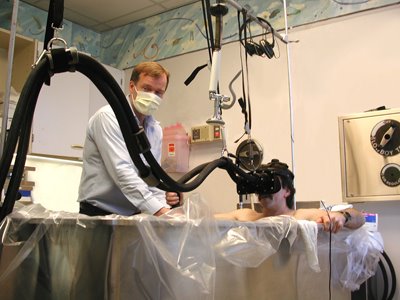
Virtual Reality Therapy does not only address psychological issues. VRT has also been used in the hospital and medical settings.
Dr. Hunter S. Hoffmann, a pioneer in Virtual Reality Therapy, recently completed a study of burn patients using headgear that allowed patients to enter a pleasant virtual reality environment as they underwent painful wound care.
Although this line of research is just beginning (with funding from NIH, the Paul Allen Foundation), results indicate a significant decrease in pain that patients experience[3].
And researchers at Emory University School of Medicine, Virtually Better Incorporated, and The National Institutes of Health (NIH), are testing the use of Virtual Reality Therapy to find out if it can help people with lower back pain learn how to relax, breath properly, and manage their pain [4].
Footnotes
[1]Schare, M. (2005) Virtual Reality Psychotherapy: Anxiety Treatment and Beyond. Nassau County Psychological Association Annual Conference, Garden City, New York, 10/28/2005.
[2] Virtually Better Website: http://www.virtuallybetter.com/
[3] Scientific American Hoffman, H. (2004) Virtual Reality Therapy accessed @ http://www.sciam.com/print_version.cfm?articleID=000CDC34-D80E-10FA-89FB83414B7F0000
[4] Emory University: http://www.whsc.emory.edu/pressreleases2.cfm?announcementidseq=2539