Pages

.

More Fun With Psychology


Look at this picture.
Does it move?


Perception and the mind's eye are at work here again. This is a stationary picture. It is NOT moving, but when we look at it, it MOVES.


Try this one. It's called "Slow Gears" - based on the work by A. Kitaoka.


Afterimages from our peripheral vision create "perceived movement" . Our mind then tells us that the image IS moving.


Okay, fun time is over.


References

Brain Basher Illusions

Illusionworks


reade more... Résuméabuiyad

Depression and Smoking

(HealthDay News) -- Adding to the growing evidence that mental illness in childhood can lead to problems later in life, a new Finnish study suggests that depressed kids are more likely to grow up to become smokers.

Researchers who tracked 2,300 boys over a 10-year period reported that those who had symptoms of depression at age 8 were 20 percent more likely than others to smoke at age 18. The depressed boys were also 40 percent more likely to become heavy smokers. The study is apparently the first to find a link between childhood depression and adult smoking in a large sample of people, the researchers said. The findings were presented on May 25, 2006, at the American Psychiatric Association's annual meeting, in Toronto. For more on this story go here

Hmmmm, I wish they studied girls too.

I was a depressed child and am an adult who takes medication for depression. But I never smoked. Tried it once, hated it. Now, chocolate on the other hand....

Does this research generalize to any of you reading this?

Resources
APA Toronto 2006 Conference
Healthday
reade more... Résuméabuiyad

Benefits of Power Napping


I am the Queen of napping. I can nap anywhere, anytime. It's one of my many talents. Even my cat is in awe of my skills.

Around 2:30 everyday, I am at rest. I'm in a semi-conscious state - not sound asleep but not fully awake. I can ease out of this wonderful place without a jarring effect. And when I emerge from my catnap, some 20 minutes later, I feel so good.

The benefits of napping have been well documented. Research has shown that a nap can promote physical well-being, improve mood and memory, sharpen senses and revitalize a person. The neurons in brain functioning get to rest and recuperate from the day's stress. Intellectual performance improves from the boost a midday nap provides and accuracy in performance increases too. MRI's of nappers show that brain activity stays high throughout the day with a nap. Without one, it declines as the day wears on.

Research also says that taking a nap of 30 minutes a day is better than sleeping 30 minutes later in the morning. And from another psychological perspective, falling into a light sleep can feel meditative (like my semi-conscious experience). As you nap, the dreams and streams of thoughts you experience may offer insights you may not be able to grasp at night when you are in a deep sleep.

When you sleep under normal circumstances, your brain cycles through several different stages of Delta, Theta, Alpha, Beta, and Gamma sleep waves. You drift from one stage of sleep to another - from light sleep to deeper sleep to REM sleep to wakefulness and so on. Delta and Theta sleep, also known as Sleep I and Sleep II stages, are light stages of sleep. So, the key to napping is to not fall into the deeper stages of sleep. That's why a 15 to 30 minute nap is recommended. Napping more than that, and you'll find yourself waking up cranky or groggy.

The good old catnap has new names, like "The Power Nap", "Powernapping" and "Metronapping". In fact, there is an emerging trend where science fiction-like pods and snoozing suites are popping up in workplaces, universities, and malls. Take a look here and here

Some famous self-proclaimed nappers include Albert Einstein, Leonardo Da Vinci , Thomas Edison, Winston Churchill, Johannes Brahms, John D. Rockefeller, Eleanor Roosevelt, Gene Autry, Nikola Tesla, Bill Clinton, John F. Kennedy, Napoleon Bonaparte, Salvador Dali and Sylvester Stallone.

So, science and psychology say we should embrace the siesta - and not view the snoozing in the middle of the day as being lazy. Napping is not just for the young and the old. It can be a good thing for us all.


References

Hayahsi, M.; Motoyoshi, N.; Hori, T. (2005). Recuperative power of a short daytime nap with or without stage 2 sleep. Sleep, 128:829-36.

Mednick, S.l Nakayam, K.; Stockgold, R. (2003). Sleep-dependent learning: A nap is as good as a night. Neuroscience, 6(7): 697-698.

Mednick, S. & Stickgold,R. (2002). The restorative effect of naps on perceptual deterioration. Nature Neuroscience. 5(7): 677-681.
reade more... Résuméabuiyad

Psychology of Shopping


Psychology is used in many ways. Here's something that I came across and thought I'd share. It's a short quiz on the psychology of shopping provided by the entertainment site, Queendom.com.


Which of the following fields determines if a retail store "works" or "doesn't work"?

_ Retail anthropology
_ Retail Psychology
_ Marketing
_ Market Research


What color has market research found makes customers feel like spending money?

_ Red
_ Dark green
_ Light purple
_ Neutrals


Upon entering a store, most shoppers head in what direction?
_ Left
_ Right
_ Straight ahead
_ It depends on the store.


Get your answers by taking the rest of the test here


My grade?
A gigantic F.
I only got 3 answers correct....but I learned so much!

Reference
Queendom.com/
reade more... Résuméabuiyad

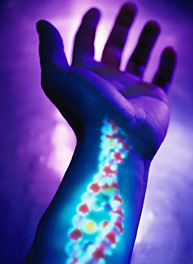
Genetics and Sexuality: The Gay Gene


In a new study, researchers looked at 97 mothers of gay sons and 103 mothers without gay sons to see if there was any difference in how they handled their X chromosomes. The findings appear in the February 2006 issue of the journal Human Genetics. The research "confirms that there is a strong genetic basis for sexual orientation, and that for some gay men, genes on the X chromosome are involved," said study co-author Sven Bocklandt, a postdoctoral researcher at the University of California at Los Angeles.

"When we looked at women who have gay kids, in those with more than one gay son, we saw a quarter of them inactivate the same X in virtually every cell we checked," Bocklandt said. "That's extremely unusual." Forty-four of the women had more than one gay son. In contrast, 4 percent of mothers with no gay sons activated the chromosome and 13 percent of those with just one gay son did. The phenomenon of being more likely to inactivate one X chromosome -- known as "extreme skewing" -- is typically seen only in families that have major genetic irregularities, Bocklandt said.

What does this all mean? The researchers aren't sure, but Bocklandt thinks he and his colleagues are moving closer to understanding the origins of sexual orientation.

Dr. Ionel Sandovici, a genetics researcher at The Babraham Institute in Cambridge, England said, "We're trying to understand one of the most critical human traits: the ability to love and be attracted to others. Without sexual reproduction we would not exist, and sexual selection played an essential role in evolution," he said. "Yet, we have no idea how it works, and that's what we're trying to find out. "

This research suggests that genetics may play a part in sexual orientation. This is a vast difference than decades ago, where earlier versions of the DSM regarded homosexuality as a mental disorder. Genetic research rocks.


Resources:

Bocklandt, S. ; Horvath, S.; Vilain, E.; Hamer. D.H. ; Sandovici, I. (2006) Extreme skewing of X chromosome inactivation in mothers of homosexual men. Human Genetics, 118(6): 691-694.

The Gay Gene @ Frontline.
reade more... Résuméabuiyad

Mother's Day: Easy or Queasy?


Mother's Day is a holiday that is marked world-wide. Countries such as the United States, Canada, The UK, Australia, China and Japan, just to name a few, highlight the day on their yearly calendar.

Historically, Mother's Day has been a day where children and other family members honor mothers or individuals who are nurturing and caretaking in maternal ways. For some, it is a day of celebration, of expressing one's love and appreciation for a mothering figure. The day is met with happiness and the sharing of joyous memories of times past and the anticipation of good times to come.

However, for others, Mother's Day is not so easy. It can bring forth sadness, loss and yearning if one's mother has died. Or if a mother has lost a child, it can become an excruciating day filled with grief. Anger and resentment can be felt by those who've never had a good relationship a mother.

In my work, anniversary dates or holidays can be especially difficult for anyone who's experienced loss, death or the recognition of toxicity in a relationship. Of all the days in the calendar year, Mother's Day and Father's Day evoke the most profound emotional responses.

To those of you who struggle with Mother's Day, know that you're not alone. Give yourself permission to feel and think whatever comes from within. On this day, it's important for your to mother yourself.


reade more... Résuméabuiyad

Alexithymia: What the Heck *Is* That?


Many believe that recognizing emotions is an automatic thing.

An instinct.

A given.

But, actually, there are many people who have trouble identifying their own feelings.

The clinical name for this is "Alexithymia" ~pronounced (Alex-ee-time-eeya) .

People who experience Alexithymia are unable to recognize their own emotions and their subtleties, to understand or describe these emotions, and they sometimes misunderstand the emotional experience of others.

Alexithymia was coined from the Greek word LEXIS, ("word") and THYMOS ("feelings"), and literally means "a lack of words for feelings".

Alexithymia has not been a well publicized issue and most professionals as well as non-professionals know little or nothing about it.

Alexithymia is not a disorder, but is seen as a trait. Some characteristics noted are:

*Difficulty identifying different types of feelings

*Difficulty distinguishing between emotional feelings and bodily feelings

* Limited understanding of what caused the feelings

* Difficulty verbalizing feelings

* Limited imagination

* Functional, constricted style of thinking

* Physical complaints

* Lack of enjoyment and pleasure-seeking

* Stiffened posture and/or facial expressions

Many individuals who have Alexithymia can sometimes find themselves doing counterproductive non-verbal activities to communicate their feelings. Activities like cutting, or breaking things, engaging in drinking or dabbling in drug use, for example. Learning to recognize feelings to productively verbalize and communicate is the goal here. And the goal is also to find productive non-verbal activities like art, exercise, and sports to allow for more meaningful experiences in life.

Alexithymia is not something to be afraid of. If you experience this, or know someone who does, there are ways to learn how to strengthen skills. Often a speech language therapist and/or a mental health professional can help to show you the way.


References:
Taylor, G. J., & Bagby, R. M. (2000) An overview of the alexithymia construct, in ed. R. Bar-On & J. D. A. Parker, The Handbook of Emotional Intelligence, San Francisco: Jossey-Bass Inc., Ch.3, pp.41-67.
reade more... Résuméabuiyad