Pages

.

Angry Faces


What an angry face this little baby has, wouldn't you agree?

An article from the June 2006 journal of Current Biology supports research on how angry facial expressions are a priority when visually processing aspects in our world.

We are instinctually wired to be attuned to threatening faces in our environment. In fact, there are specific brain regions that are dedicated to processing threatening facial expressions.

In evolutionary terms, knowing what was dangerous helped our ancestors to survive. Psychologically speaking, sensing the threat set into motion a variety of defenses that enabled our ancestors to move through the emotional experience of danger.

We still rely on this wiring today. When we see the angry boss coming or view a threatening situation, our defensive strategies are activated. If danger can be seen, we can respond.

But, sadly, there are many times that we don't see the danger coming. Our visual scanning doesn't pick up the angry face because it is masked. We don't see the dangerous person that lingers underneath the non-threatening face. We are simply not wired for that.

The best we can do when we are confronted with a wolf in sheep's clothing is to get out of harm's way as fast as possible - with no self-blame or self-reproach.

Now, back to this angry face...I wonder what made this little baby so mad?


Reference
Williams, M. & Mattingley, J.B. (2006) Do angry men get noticed? Current Biology, 16, R402-R404.
reade more... Résuméabuiyad

The Black-and-White Of Low Self-Esteem

People who see their relationships as either all good or all bad tend to have low self-esteem, according to a series of seven studies by Yale researchers published in the Journal of Personality and Social Psychology .

The findings suggest that those who had low self esteem found it hard to think of their partners as a mix of positive and negative characteristics at a given point in time. Those with higher self-esteem were able to hold onto both the good and bad aspects of their partner and see them in the gray, instead of in black-and-white.

Researcher Dr. Margaret Clark says, " In good times, those low in self-esteem tend to idealize partners, rendering those partners safe for approach and likely to reflect positively upon them. At the first sign of a partner not being perfect, however, they switch to focusing on all possible negatives about the partner so as to justify withdrawing from that partner and not risking vulnerability."

Low self-esteem can have other devastating consequences.

* It can create anxiety, stress, loneliness and increased likelihood for depression.

* It can cause problems with friendships and relationships.

* It can seriously impair academic and job performance.

* It can lead to underachievement and increased vulnerability to many self destructive behaviors.

* Worst of all, these negative consequences themselves reinforce the negative self-image and can take a person into a downward spiral of lower and lower self-esteem.


The Good News

The good news is that though self-esteem is largely developed during childhood, it can be increased and strengthened. According to the University of Texas at Austin Counseling Center, three steps can help you get there.

Step 1: Rebut the Inner Critic: Challenge the negative messages of your critical inner voice. This means that you have to counter your negative self-thinking with positive mantras.

Step 2: Practice Self-Nurturing: Healthy self-esteem begins when you treat yourself as a worthwhile person. Start to challenge past negative experiences or messages by nurturing and caring for yourself in ways that show that you are valuable, competent, deserving and lovable.

Step 3: Get Help from Others: This can be the hardest step. People with low self-esteem often don't ask for help because they feel they don't deserve it. But since low self-esteem is often caused by how other people treated you in the past, you may need the help of other people in the present to challenge the critical messages that come from negative past experiences. Find good role models, healthy loving people with whom you can share your time, thoughts and experiences.

Viewing yourself, your partner or the world in black-and-white short-changes everything. Life should be filled with a palette of colors.


References

Clark, M. & Graham, S. (2006) Self-esteem and organization of valenced information about others: The jekyll and hyde-ing of relationship partners. Journal of Personality and Social Psychology. 90(4): 652-665.

reade more... Résuméabuiyad

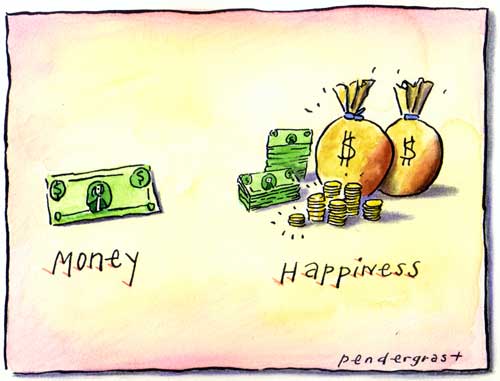
Money Can't Buy Happiness - Or So Research Says


Dr. Arthur Stone, Psychologist and Researcher at The State University at Stony Brook, has discovered what philosophers have long known: Money doesn't make people happier.

In a study that appears in this month's Science , Dr. Stone along with researchers at Princeton University, the University of Michigan and the University of California in San Diego, explored the relationship between money and happiness.

"It's mostly illusory," Stone said. "When you look at people's actual experience, the rich are not happier than others. And if they are, it has little to do with the money they have."

I don't know if I completely agree.
I think that money can help lighten aspects of strain and anguish, poverty and despair. In turn, wouldn't that bring a sense of relief and joy? Maybe I am being too semantic about this.

What do you think?


References
Newsday
Stone, A. (2006) Would You Be Happier If You Were Richer
reade more... Résuméabuiyad

Depression and Your Heart


"A broken heart"
"Oh, this is such heartache"
"Follow your heart"
"That's a heartfelt thought"

Maybe you've used them to describe how you feel - - or perhaps you've heard such phrases from other people. Either way, the heart is more than an life sustaining organ. It is a symbol of feelings and thoughts too.

And a new study published in the Journal of the American Medical Association (JAMA) shows that depression is more common among patients with heart ailments.

In fact, over at A Hearty Life you can read statistics like this:

1 in 20 people in the general population has depression.

1 in 5 patients with coronary heart disease has depression.

1 in 3 patients with congestive heart failure has depression.

And as many as half of all people hospitalized for surgery or other procedures to treat blocked heart arteries develop depression.


Unfortunately, despite its prevalence, depression continues to be underdiagnosed and undertreated by primary care physicians, cardiologists, and other specialists. But knowledge is power, so pass this on to someone you know, and let's kick depression outta here.


Hat Tip: Dr. Hsien-Hsien Lei at A Hearty Life
reade more... Résuméabuiyad

Grand Rounds: 2:39


When I was in graduate school, my most enjoyable times were on Thursdays, when "Grand Rounds" was scheduled in the hospital where I had an internship. Some 20 years later, here I am still learning and sharing in the Grand Rounds tradition.


Fade-in...


Scene 1: The Mental Health Clinic

~ Anxiety, Addiction and Depression Treatments submits a post on the epidemic status of Methamphetamine abuse.

~ HealthPsych highlights a UK study which points out that physical health problems often go undetected in the mental health population.

~ Mind Hacks has a great neuropsychological post on shy children and their sensitivities to life's subtleties.

~ Over at Panic is a post on how ABC television in the United States recently followed a teen from Maine with panic disorder.

~ UK based Psychology and Crime posts about Intermittent Explosive Disorder. This little studied disorder is often seen in road rage.

~ Psych Central has a great article about Disturbing Reality Television .

~ Shrinkette posts about the political veering off that can sometimes happen when administering the Mental Status Exam

~ Mediblogopathy highlights the often funny and inappropriate ongoings in a psychiatric hospital.

~ Read about Adaptation Theory and "setpoint of well-being" over at StaffPsychologist


Scene 2: The Medical Center

~ Kevin, M.D. dovetails a post with the latest obvious new of the day that Emergency Rooms are in crisis. Dr. Flea's Blog persuses this same subject as well in his post "Growing Pains, Indeed".

~ Charity Doc has a post about a real-life emergency medicine drama. It's filled with action, conflict, tragedy and the emotional fallout of it all.

~Over at Pediatricsinfo.com is a must read piece on Merck's Human Papilloma Virus vaccine for girls and women. The Nurse Practitioner's Place echoes similar sentiments, but the worry hits home even more as a family member receives a positive diagnosis for HPV.

~ Find out how helium and MRI's are better detecting smoking-related lung damage at straightfromthedoc.com

~ Head on over to Diseaseproof.com where Dr. Joel Furhman blogs about how to lower one's cholesterol naturally. Medical needs and health benefits of water and whole_foods are discussed at Wellness Tips. Dr. Emer over at Parallel Universe has a post on lawsuits and Trans Fatty Acids. And who'd a thunk that cannabinoid-lowers-blood-pressure ?!?

~ New blogger OncRN has a moving post on when the Code Team has to Call It . And Home- School-Med-Student blogs about this subject as well, writing about her first experience in a Level 1 Trauma Center .

~ Interested-Participant has a post about the British Medical Association backing non-voluntary euthanasia for patients who are too ill to ask for death.

~ Over at allergizer.com is an important post on how certain groups of mold increases the likelihood of developing multiple allergies later in life.

~ Pixel RN accounts the down and dirty aspects of an ICU room.

~ Good Ol' Grunt Doc offers up a rant on cultural differences and language acquisition.

~ Over at http://www.njurology.com/RoboticSurgeryBlog/ is an informative post on sexual life after prostate removal.

~ And Stork Doc takes us through the stages of diagnosis and surgery of a patient who initally presented with anemia but was, in actuality, bleeding to death.


Scene 3: The Patient Waiting Room

~ Nakedmedicine.com has a great post by Dr. Jane Chin, who writes from her own patient perspective "Why We Like The Doctors We Like".

~ Dr. Charles writes here about the fear patients still have about genetic discrimination.

~ Emergiblog has an interesting story about a patient and decides, herself, that "Eccentricity is NOT a Crime."

~ Cancer Commentary reports that only one in ten cancer patients are aware of clinical trial opportunities. An alarming statistic, if you ask me.

~Over at Pearls and dreams , the do's and don't with Myasthenia Gravis are considered in the post "Can You Do That?" By the way, I would like to add that June is MG awareness month.


Scene 4: The Insurance and Healthcare Facility

~ InsureBlog asks if HIPAA really protects personal medical records. Some folks don't think so, and they blame the government for lackadaisical enforcement. Are they right?

~ The Specialty Insurance Blog has an interesting post on a recent Medical Malpractice Study

~ Blogcharm posts about the concerns the AMA has with NP's taking charge of clinics in store locations.

~ And Clinical Cases and Images Blog wonders if physicians can benefit from "Google Office" and updates us on how the Cleveland Clinic is offering podcast and videocasts.

~ A great post can be found at Fixing Healthcare which suggests that "health" rather than "sickness" should be the focus in heathcare.

~ Msspnexus.blogs has a rather sad tale of an escalating war between a large group physician practice and a fairly small hospital in rural New York.

~ The Medical Blog Network has a post on how it's been helpful in hosting blog carnivals and talks about where the healthcare blogosphere is heading.

Scene 5: The Pharmacy

~ The Pharm Voice blogs about the approval Schering AG Germany has to continue making Betaferon® - the only high-dose high-frequency therapy approved for the treatment of the earliest stages of MS.

~ Diabetesmine.com blogs on the buzz on a new insulin pill, Intesulin - - which is showing that it is 60-70% as effective as injected insulin.

~ Pycnogenol® may reduce the symptoms of ADHD as noted in the post at Biotechweblog

~ Over at the Health Business Blog is a post about the tragedies and business opportunities of "Pharm Parties".


Scene 6: The Coffee House

~ Navelgazing Midwife writes about her first time learning how to do a vaginal exam.

~ Over at Urostream is a fun post on how one's professional training can pay off.

~ Read a beautiful poem written for a pediatric cancer patient from Dr. Sidharth Sethi's blog.

~ Cathy writes about her mother's Alzheimer's and the cruel reality of the disease's progression.

~ Dr. Hsien Hsien Lei brings us a post about a man passed over by passersby while having a heart attack at A Hearty Life . A rather sad commentary on the state of human compassion.

~ You'll be sure to laugh when Milliner's Dream offers a student nurse diagnosis of her husband's strange skin discoloration.

~ Mexico Med Student blogs about the things he's learned in his first year of medical school.

~ But have some tissues ready before you read Today We Say Goodbye from Digital Doorway, a nursing blog -- and the personal story entitled Love Shouldn't Ever Leave Bruises at All Blogged Up: A Moof's Tale.


~ Cutaway to ~

Next Grand Rounds Production is slated for: June 27, 2006
Directed by: Dr. Stuart Henochowicz at Medviews


And fade-out ...
reade more... Résuméabuiyad

Ringxiety: The Next New Disorder


Do you have the sensation that your cell phone is ringing or vibrating when it's not?

If so, you may have RINGXIETY.

Dr. David Laramie, from California's School of Professional Psychology, is the originator of the term and experiences "Ringxiety" as well. According to Dr. Laramie, people have grown emotionally dependent on cell phones for feelings of self-worth or for needing to be connected. Some more snarky experts think that "Ringxiety" is a need to feel popular, while sound experts believe hearing sounds that seem like a telephone's ring send an expectant brain into action, a checking-the-phone-reflex, so to speak. Whatever the origin, it appears that these needs cause people to be so desperate not to miss a call that they hear phones ringing or feel phones vibrating even when they are not.

I have the opposite of "Ringxiety". My phone is never on. I rarely use it. I spend money just to have it. I think the name of that disorder is "Sqaunderitis".


References
New York Times
Wordspy
reade more... Résuméabuiyad

More Fun With Psychology


Look at this picture.
Does it move?


Perception and the mind's eye are at work here again. This is a stationary picture. It is NOT moving, but when we look at it, it MOVES.


Try this one. It's called "Slow Gears" - based on the work by A. Kitaoka.


Afterimages from our peripheral vision create "perceived movement" . Our mind then tells us that the image IS moving.


Okay, fun time is over.


References

Brain Basher Illusions

Illusionworks


reade more... Résuméabuiyad