Pages

.

The Ghost Network


If you live in the United States, has this ever happened to you?

You call a psychologist, social worker of psychiatrist who is "on your plan" only to find out that they "are not" on your plan?"

Have you found yourself feeling disgusted and exhausted from this experience, and deciding not to go further with finding a therapist?

Consider yourself haunted... By a Ghost Network.

A Ghost Network, also called a Phantom Network, is a collective list of doctors and specialists that your insurer insists are contracted providers for your medical or mental health needs. However, many of these identified individuals are not members of the network [1].

I have been part of a Ghost Network, haunting the managed care company of Group Health Insurance, for almost a decade. I do not participate with them, have signed no contract with them - - yet, year after year, they have my name in their panel of specialists. Many potential patients call my office thinking that I am in their plan, only to discover I am not. I do not participate with *any* managed care companies because I think they are unethical in the way they regulate health care, but that is for another post.

When the person calling discovers that I am not in their network, I always help them try to find a good therapist... and I always educate them about the Ghost Network they have found themselves in. I tell them to inform their employer and colleagues about the situation so that the next time a choice for a different insurance coverage comes up, a change can occur. Managed Care companies sell their services by "showing off" the list of specialists they have in their network. The Managed Care organizations that use a Ghost Network are engaging in fraudulent behavior and bad faith, making promises they cannot deliver. Before my phone call ends, I tell them to call GHI to share their dismay as well. I am not the only ghost haunting GHI or other insurance and managed care organizations. This is a rampant problem in the United States!

The real issue here is the method behind the madness...Insurance companies and managed care companies want you, the person looking for help, to get frustrated. They want you to fatigue and get disgusted in the hopes that you will chuck all your plans for intervention or treatment. Yes, Ghost Networks are about making money.

Ghost and Phantom Networks are very difficult with which to get removed. I have written, faxed and called many, many times over the years, only to learn that I am still haunting and lurking in spirit. There are even deceased practitioners listed in Phantom Networks. I wonder how they sign their yearly contracts?

Ghost Networks are widespread throughout the United States says Dr. Lawrence Lurie, chair of the APA Committee on Managed Care. Dr. Russ Newman agrees and adds,"When a consumer tries to access the promised benefit, he or she finds that many of the health professionals on the provider list are simply 'phantoms' of managed-care marketing and not really available" [2]. The legal issue here is that you are entitled to a specialist for your needs. If there are no specialists because of the Ghost Network practice, your are entitled to have one at no additional cost to you. You can find the specialist if one is not provided for you. Many people do not know this.

The National Coalition of Mental Health Professionals & Consumers wants to know about the experience that you have had with a Ghost or Phantom Network. If you have found yourself unable to access covered mental health or medical services because you can't find a professional in the network they want to know. This grass roots movement is a great resource. You can also contact your State Attorney General to file a complaint should you be unable to find a health care practitioner.

How does finding a therapist or doctor work in other countries...are there obstacles too?

Good services should never be hard to find!


Footnotes
[1] Psychiatric News:
http://www.psych.org/pnews/00-11-03/its.html
[2] American Psychological Association:
http://www.apa.org/monitor/feb02/phantoms.html
[3] National Coalition of Mental Health Professionals & Consumers
http://www.nomanagedcare.org/article.html


References
Citizens for the Right To Know:
http://www.rtk.org/grievance.htm

How to Play HMO Hardball:
http://www.hmohardball.com

National Alliance for the Mentally Ill:
http://www.nami.org

American Board of Examiners in Clinical Social Work:
http://www.abecsw.org

The American Psychiatric Association:
http://www.psych.org/

The American Psychological Association:
http://www.apa.org

The American Counseling Association:
http://www.counseling.org

The American Medical Association
http://www.ama-assn.org/

The American Mental Health Alliance
http://www.americanmentalhealth.com/

The Clinical Social Work Federation:
http://www.cswf.org

The National Coalition of Mental Health Professionals and Consumers
http://www.thenationalcoalition.org/

The Unites States Senate Site Patient's Bill of Rights:
http://www.senate.gov/~dcp/patients_rights
reade more... Résuméabuiyad

Famous Psychology Quotes


People are like stained glass windows. They sparkle and shine when the sun's out, but when the darkness sets in, their true beauty is revealed only if there is light within.
~ Elisabeth Kubler-Ross (1926-2004) Swiss American Psychiatrist & author.


"Thought is action in rehearsal."
~ Sigmund Freud (1856-1939) Austrian founder of psychoanalysis


"Success is a state of mind. If you want success, start thinking of yourself as a success."
~ Dr. Joyce Brothers (1928-) American psychologist, TV-radio personality, columnist & author.


"Education is not just the filling of a pail, it is the lighting of a fire."
~ B. F. Skinner (1904-1990) American psychologist


"Your vision will become clear only when you look into your heart. Who looks outside, dreams. Who looks inside, awakens." ~Carl Jung, (1875-1961),Swiss psychiatrist, psychoanalyst


"Hate is a product of the unfulfilled life."
~ Erich Fromm (1900-1980) American psychologist, psychoanalyst.


"When I look at the world I'm pessimistic, but when I look at people I am optimistic."
~Carl Rogers (1902-1987), American psychologist.


"The only normal people are the one's you don't know very well."
~ Alfred Adler (1870-1937), Austrian psychologist.


"All the art of living lies in a fine mingling of letting go and holding on."
~Henry Ellis (1859-1939), British Psychologist


"Sex is not a sin. Many people have complained that this is taking all the fun out of sex."
~ Ruth Westheimer (1928 - ), German-American psychologist, TV radio personality & author.


"If you only have a hammer, you tend to see every problem as a nail."
~Abrahamm Maslow (1908-1970), American psychologist.


"All of us are much more human than otherwise. "
~Harry Stack Sullivan (1892-1941), American psychologist.


reade more... Résuméabuiyad

Blogging Seen As Good Therapy


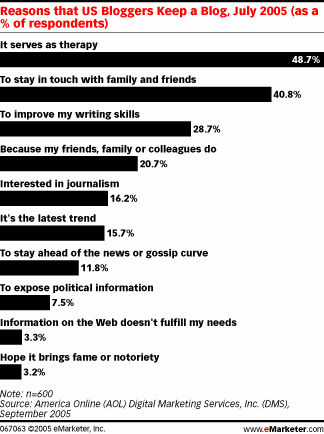
A new study finds that blogs are more likely to deal with personal matters than politics or current events, and nearly 50% of bloggers see the activity as a form of therapy.

According to an AOL survey conducted by Digital Marketing Services Inc., many bloggers write about "anything and everything." But while blogs often include comments on news topics, they are more likely to be about friends, family and other personal interests.

Although bloggers say they write about personal matters on their blogs, 43.9% of respondents said that they read other blogs to get a different perspective on the news. These findings are similar to a Harris Interactive survey from March 2005, which found that about 44% of US Internet users read political blogs, including 16% who read them less than once a month. And although most bloggers read other blogs, the AOL survey found that almost one-quarter of them do not.

About one-half of bloggers (48.7%) keep a blog because it serves as a form of therapy, and 40.8% say it helps them keep in touch with family and friends. Just 16.2% say they are interested in journalism, and 7.5% want to expose political information. Few see blogging as their ticket to fame.

Bill Schreiner, Vice President, AOL Community, puts it in perspective: "In a way, blogs serve as oral history. When it comes to sharing blogs and reading other people's blogs, we like to connect with people, learn about their lives, and find common ground. There's no pressure to write about a particular subject or keep blogs maintained a certain way, and it's not necessarily a popularity contest."

©2005 eMarketer Inc. All rights reserved @ http://www.emarketer.com/Article.aspx?1003595
reade more... Résuméabuiyad

Psychological Reactions To Disaster


In light of the devastation and suffering from the aftermath of Hurricane Katrina, this list is offered to help individuals understand "Disaster Reactions". Witnessing a traumatic event sets into motion a variety of psychological reactions. These psychological reactions have physical, cognitive, emotional and behavioral presentations. This list is not exhaustive but serves to illustrate many of the reactions people experience.


Psychological Reactions

•Anger
•Anxiety
•Apathy, diminished interest in usual activities
•Appetite change
•Avoidance
•Blame
•Confusion
•Criticalness
•Decreased sexual interest
•Denial
•Depression
•Difficulty concentrating
•Difficulty making decisions
•Difficulty using logic
•Difficulty naming objects
•Difficulty focusing
•Disorientation
•Distortions in time perspective
•Exaggerated startle reaction
•Excessive worry about safety of others
•Emotional numbing
•Fatigue
•Faintness or dizziness
•Fearfulness
•Feelings of being unappreciated
•Feelings of inadequacy
•Feelings of loss
•Feelings of gratefulness for being alive
•Feelings of isolation or abandonment
•Feeling high, heroic, invulnerable
•Feeling a “lump in the throat”
•Feeling uncoordinated
•Forgetfulness
•Frustration
•Grief
•Guilt
•Headaches
•Helplessness
•Hyperactivity or an inability to rest
•Increased heartbeat, respiration, blood pressure
•Increased alcohol use or substance abuse
•Intense concern for family members
•Inability to express self verbally or in writing
•Irritability
•Letdown
•Loss of appetite
•Loss of objectivity
•Lower back pain
•Memory problems
•Muffled hearing
•Nausea, upset stomach, diarrhea
•Nightmares
•Numbness
•Pains in chest
•Periods of crying
•Persistent interest in the event
•Persistent or obsessive thoughts
•Sense of being in a bad dream
•Sense of unreality or being in a movie
•Shock
•Sleep disturbance
•Slowness of thinking, difficulty comprehending
•Social withdrawal, distancing, limited contacts with others
•Soreness in muscles
•Stomach and muscle cramps
•Strong identification with victims
•Strong identification with survivors
•Sweating or chills
•Tremors, especially of hand, lips, eyes
•Trouble catching breath
•Visual flashbacks
•Withdrawal


Coping with Disaster Stress

1. Stay active. Falling into passivity can worsen psychological and physical disaster reactions.

2. Resume a normal routine as soon as possible.

3. Remind yourself that you are normal and having normal reactions in the face of the disastrous event. It is especially important to teach children that reactions like these are normal.

4. Be aware of numbing the pain with overuse of drugs or alcohol.

5. Avoid caffeine as its effects can amplify anxiety.

6. It is all right to spend time by yourself, or on the other hand, feel the need to be with others.

7. Avoid over-exposure to media images and newscasts.

8. Realize that those around you are also under stress and may not act or react in a manner you would normally expect.

9. Keep a journal or start a blog. Written expression can have healing benefits.

10. Make decisions that will give you the control over your life.

Of course, consult a mental health professional if you need assistance in coping with disaster-related stress reactions.
reade more... Résuméabuiyad

The Anniversary Effect

Birthdays.
Thanksgiving.
Christmas. Kwanzaa. Hanukkah.
Halloween. Carnivale. New Year's Day. Cinco de Mayo.
Bastille Day. Boxing Day. Labor Day. Independence Day.
The first day we met.
The last day of school.
There are so many dates that mark occasions throughout the year that bring us happiness. But there are days in the calendar year that make us feel unsettled. These dates go unnoticed. Not that we don't remember them, but unnoticed as to how that date presses on our psyche. This experience is known as "The Anniversary Effect".


What the Anniversary Effect?

"The Anniversary Effect" or an anniversary reaction may be defined as upsetting behavior, reactivation of symptoms, and/or distressing dreams that occur on an anniversary of a significant experience. Sometimes we know why we are feeling melancholy, irritability or anxiety. For example, 9/11 holds an anniversary effect for many Americans and others in the world. And now, hurricane Katrina will also hold anniversary reactions for survivors and those who witnessed its aftermath. These dates will continue to be recognizable sources for our psyche's disturbance. We have conscious awareness of these dates and events. We are aware of the trauma time-line and the current calendar time-line[1]. Anniversary dates that are known to us enable us to identify why we are upset or in mourning. We connect the dots from our current emotional state to the trauma date or the traumatic event. Other obvious dates make the anniversary reaction traceable: birthday of a loved one that is not living, the date of an accident, a loved one's death, the holiday time when something traumatic happened, just to name a few.

But, there are dates that have a time-specific relationship to us that are not recognized or readily made conscious to us in the calendar year [2]. There is no conscious awareness of the trauma or calendar time-line. These "Anniversary Effects" take us by surprise. We don't know why we are feeling so down, anxious, upset, lost, or confused. Our bodies take on the psychological impact of the anniversary date, and we can also feel physically ill or sick. For example, the date you signed your divorce decree, not the day your loved one died but the day of the burial, listening to certain song that elicits a swirl of emotions, the season of the year when your child goes off to college, the scent or smell of something that triggers a deep response in you, or a current event that recalls a trauma in the past[3].

Anniversary reaction types, whether single, repetitive, or generational, are ways by which a person re-experiences mourning in an attempt to gain mastery. It is important for the individual who moves through this to realize that it is a part of the normal grieving process. In the first year of healing, a feeling of pain or anxiety may occur at the 3 month, 6 month, and one-year anniversaries of the date. After the first year, people tend to experience "The Anniversary Effect" on the year-marker. For vulnerable individuals, a specific time of day, a certain day of the week, a season of the year, a scent or a glimpse of something related to the trauma can trigger an anniversary reaction [4].


What You Can Do

Despite the fact that "The Anniversary Effect" was first identified almost 100 years ago, it is often overlooked as a source for psyche disruption. There are things that you can do to help yourself with this experience.

An anniversary marks a time of heightened vulnerability. Being aware or predicting anniversary reactions is always helpful. I often advise people I work with to look at a calendar and explore dates and memories attached to such dates. This framework can help prepare one for the anniversary reactions, and how the present day time-line can be connected to losses in the past.

Anniversaries of public trauma,crises or disasters receive significant media coverage, and re-visit imagery of damage and destruction. Such exposure can intensify "The Anniversary Effect" --- so it would be important to limit media watching and reading in and around those dates.

Journaling or blogging can be a helpful outlet for "The Anniversary Effect". Such expression can provide an opportunity for emotional healing. By recognizing, allowing and attending to feelings, memories and thoughts, an individual can make significant steps forward through the natural process of grief [5].


References


[1] Mintz, I. (1971). The anniversary reaction: A response to the unconscious sense of time. Journal of the American Psychoanalytic Association, 19, 720-735.

[2] Campbell, R. (1981). Psychiatric dictionary. New York: Oxford University Press

[3] Dlin, B. (1985). Psychobiology and treatment of anniversary reactions. Psychosomatics, 26, 505-520.

[4] Pollock, G. H.(1971). Temporal anniversary manifestations: Hour, day, holiday. Psychoanalytic Quarterly, 40, 123-131

[5] Myers, D. (1994). Disaster response and recovery: A handbook for mental health professionals. Rockville, MD: Center for Mental Health Services.
reade more... Résuméabuiyad

Body Image and Self Worth In Women

~~~~~~~~~~~~~

Images of female bodies are everywhere. Women and their body parts sell everything from food to cars. Researchers report that women's magazines have 10 1/2 times more ads and articles promoting weight loss than do men's magazines, and over 3/4 of the covers of women's magazines include at least one message about how to change a woman's bodily appearance by diet, exercise or cosmetic surgery.

Film and television actresses are becoming younger, taller and thinner. Some have even been known to faint on the set from lack of food. These industries all insist that thin is beautiful and that fatness is always a dangerous problem in need of correction [1]

Why are standards of beauty being imposed on women, the majority of whom are naturally larger than any of these models and actresses? The roots, researchers say, are economic. By presenting the ideal body, the cosmetic, diet and product industries are assured of growth and profits. And it's no accident that youth is increasingly promoted, along with thinness, as an essential criterion of beauty. The stakes are huge. On the one hand, women who are insecure about their bodies are more likely to buy beauty products, new clothes, gym memberships, and diet aids, just to name a few. It is estimated that the diet industry alone, in the United States, earns over 100 billion dollars a year. Sadly, research indicates that exposure to images of thin, young, air-brushed female bodies is significantly linked to depression, loss of self-esteem and the development of unhealthy eating habits in women and girls[2]

Another important aspect to realize is the vicious circle that perceptions of beauty hold in society. Young girls and young women are not only exposed to unreal aspects of body image in media, but also on the home terrain. Sometimes parents impose messages of fatness or largeness as being unacceptable, and thinness and smallness as more desirable. Words that are chosen can shape a young girl's body image and growing sense of confidence. "Those jeans make you look fat " will certainly cause a wave of insecurity. Choosing words that enhance beauty rather than emphasize a negative aspect of a person are much better choices. "Those jeans don't flatter you, I think these jeans are beautiful on you," would be a much wiser exchange.

Boys learn at an early age what is desirable, albeit unrealistic, from media and social messages at home and at school as well. Often they perpetuate the cycle, befriending girls who come close to the ideal image and casting aside those who don't. The circle is regrettably sealed when these boys mature to men who continue to objectify women in unrealistic ways.

As a young girl hears the words and messages of thinness, she can become indoctrinated into the world of unreal beauty. The cycle that starts with media, moves within the home and social world of the girl becomes internalized within her. Then she talks to herself in ways that perpetuate the myth of beauty. When failure occurs, as it always does, self image plummets and self worth is questioned.

What helps to break this cycle are indiviudals who break the mold that has been unrealistically cast for beauty. Helping people realize that beauty can come in many shapes and sizes will help young girls and boys redefine self image and body integrity. And it may help those who suffer with their own self worth to consider a raise in their status.


The Time For Change is Now

*Dove's "Real Beauty" campaign*
*Nike's Thunder Thighs, Big Butt & Tomboy Knees campaign*
*Seventeen and Glamour Magazine using "real life" models*


No longer are just rail-thin models showing up in fashion magazines and on billboards. Large women, or what are being called "real people," are now gracing ads of companies, magazine covers and commercials. Editors and ad executives say they are using more average women and fewer models to reflect changing body types and to help self-conscious teens see that not everyone is perfect.

This new advertising approach is especially important when one looks at child development. In late childhood and early adolescence social comparison plays a major role in self-perception. Boys look at other boys and learn to use their bodies as a tool to master the environment, where sports, strength and mastery in making, building and inventing are socially ingrained. Girls look at other girls and learn to use their bodies to attract others [3].

The shift in the industry enables young girls to see other renditions of beauty and can find more models like themselves with which to admire. Mary Pipher, author of a book about teen girls and body image, "Reviving Ophelia" says anything that shows realistic women is a step in the right direction to help girls gain self-esteem. Hopefully, Hollywood will follow the trend, showcasing girls and women whose shapes and sizes reflect the real world in which we live.

Consequences of the Unattainable Body

Pursuit of the unreal, ideal, thin beauty can result in poor self esteem, body dissatisfaction, and eating disorders [4]. Eating disorders have doubled in incidence since the 1960s, and increasingly they are striking in younger age groups. They are also increasingly occurring in diverse ethnic and sociocultural groups unlike in decades before. Interestingly, the mental illness with the highest mortality rate is not Depression. It is Eating Disorders. Up to 20 percent of those with eating disorders die from their illness [5].

Did You Know [6]

* The genes that we inherit from our mother and father determine 70% of our body weight and shape. This means that we can improve the body we were born with, but only to a certain degree.

* Pictures of models in magazines and advertisements are technically altered. This means that a computer changes their picture by making their legs longer, their stomach flatter, and their muscles bigger. Most of the pictures you see in magazines have been altered, and in fact it is humanly impossible to achieve these body types.

*Feeling badly about your body size and shape can lead to unhealthy eating habits, such as skipping meals, low-calorie diets, and may lead to an eating disorder, and eventually could result in medical problems and even death.

*Exercise is important for your health, but too much can be a bad thing. Excessive exercise may be a sign that someone is overly worried about their body size and shape. In fact, another sign that someone may have an eating disorder is that they are always worried about how much and how hard they are exercising. Excercise to be fit, not thin.

*There are no "good" foods and "bad" foods. All foods can fit into a healthy diet.


What You Can Do

1. Develop criteria for self-esteem that goes beyond appearance. Find other aspects of yourself that are worthy of celebrating.

2. Cultivate the ability to appreciate your body, especially how it functions.

3. Engage in behaviors that make you feel good about yourself.

4. Reduce exposure to noxious media images.

5. Exercise for strength, fitness, and health, not just weight control.

6. Seek out others who respect and care about your body.

7. Disengage from abusive relationships where the subject of your body is used as a weapon to minimize your self esteem.

8. Identify and change habitual negative thoughts about your body.

9. Control what you can, forget about what you can't.

10. Seek professional help if necessary.

References

[1] Boston Womens Health Collective (1998). Our bodies ourselves: For the new century. Boston: Peter Smith Publisher

[2] Beauty and Body Image in the Media accessed at www.media-awareness.ca/english/index.cfm

[3] Stephens, DL, Hill, RP & Hanson, C. (1996).The beauty myth and female consumers: The controversial role of advertising. Journal of Consumer Affairs. 28, 137-153.

[4] Thompson, JK, Stice, E (2001). Thin-ideal internalization: Mounting evidence for anew risk factor for body image disturbance and eating pathology. Current Directions in Psychological Science, 10, 180-183

[5] Garner, D. M. (1997). The 1997 body image survey results. Psychology Today, 30-84.

[6] California Dairy Council


reade more... Résuméabuiyad

In Good Company

There are many high profile individuals who experience mental illness. I feel like I'm in good company. Maybe you are too?

So read the list below and let's take stigma out of mental illness.


John Quincy Adams (US President), Lionel Aldridge (football star), Buzz Aldrin (astronaut), Alvin Ailey (choreographer), Adam Ant AKA Stuart Goddard (singer),Ann-Margaret (actor), Louie Anderson (comedian, actor), Gillian Anderson (actor), Isaac Asimov (author), Diane Arbus (photographer), Fiona Apple (musician), Ludwig van Beethoven, (composer), Robert Burns (poet), Drew Barrymore (actor/producer), Daniel Boorstin, (Former US presidential advisor), Zach Braff (actor), Art Buchwald (columnist), Oksana Baiul (skating star), Kim Basinger (actor), Ned Beatty, (actor), Syd Barrett (musician), Ludwig von Beethoven (composer), Carol Burnett (comedian), Maurice Bernard (actor), Irving Berlin (composer), Danny Bonaduce (actor), Halle Berry (actor), Kjell Magne Bondevik (Prime Minister, Norway), Steve Blass (baseball star), David Bowie (singer), Charles “Buddy” Bolden (musician), Charlotte Bronte (author), Marlon Brando (actor), Willie Burton (athlete), Barbara Bush (former First Lady - U.S.), Delta Burke (actor), Robert Borrstin (political advisor), Lord Byron (Poet), Cher (singer/actress), Dick Clark (producer/music magnate), John Candy (comedian), Ray Charles (musician), Deanna Carter (singer), Helen Caldicott (activist/writer), Dean Cain (actor), Drew Carey (comedian), Earl Campbell (football star), Eric Clapton (musician), Jim Carrey (actor/comedian), Melanie Chisholm (singer), Naomi Campbell (model), Jim Carrey (actor/comedian), Rosemary Clooney (singer), Jose Canseco (baseball star), Shawn Colvin (musician), Mary Jo Codey (First lady of New Jersey), Judy Collins (musician), Dick Cavett (TV host/writer), Courtney Cox (actor), Margaret Cho (comedian), Natalie Cole (singer), Michael Crichton (writer), Francis Ford Coppola (director), Sheryl Crow (musician), Winston Churchill (English Prime Minister), Nicolas Cage (actor), Sandra Cisneros (writer), Patricia Cornwell (writer), John Cleese (comedian/actor), Leonard Cohen (musician), Paula Cole (actor), Shayne Corson (hockey star), Judy Collins (musician), Shawn Colvin (musician), Jeff Conaway (actor), Ty Cobb (baseball star), Pat Conroy (writer), Billy Corgan (musician), Calvin Coolidge (US President), Bill Dana (comedian), John Daly (golf star), Rodney Dangerfield (comedian/ actor), Jefferson Davis (President of the Confederate States of America), Gaetano Donizetti (opera), Jonathan Davis (musician), Charles Darwin (scientist), Mike Douglas (TV host), Sandra Dee (actor), Walt Disney (entrepenuer), John Denver (musician), Dame Edna (comedian), Ellen DeGeneres (comedian/actor), Richard Dreyfuss (actor), Johnny Depp (actor), Paolo DiCanio (soccer star), Eric Douglas (actor), Charles Dickens (author), Patty Duke (actress), Scott Donie (Olympic star), Kitty Dukakis (former First Lady of Massachusetts), Albert Einstein (Nobel Prize Physicist), Michael English (singer), Queen Elizabeth, Jim Eisenreich (baseball star), Thomas Edison (inventor), Ralph Waldo Emerson (writer), Robert Evans (film producer), Jules Feiffer, (cartoonist), James Farmer (civil rights leader), Edie Falco (actress), Betty Ford (former US first lady), Carrie Fisher (actress), James Forrestal (undersecretary of US), Eddie Fisher (singer), Aretha Franklin (singer), Harrison Ford (actor), Albert French (writer), Sally Field (actress), Connie Francis (singer), Sarah Ferguson (Duchess of York), Sigmund Freud (psychoanalyst), Stephen Fry (actor), Bill Gates (Microsoft Magnate), Shecky Greene (comedian), Barbara Gordon (filmmaker), Phil Graham (Washington Post), James Gandolfini (actor), James Garner (actor), Peter Gabriel (musician), Kendall Gill (basketball star), Ruth Graham (writer), John Gisbon (pianist), Danny Glover (actor), Dwight Gooden (baseball star), Tipper Gore (Former US first lady), Carey Grant (actor), Mariette Hartley (actor/activist), Tim Howard (soccer star), Juliana Hatfield (musician), Ernest Hemingway (writer/ Nobel Laureate), Margaux Hemingway (actor), Audrey Hepburn (actor/activist), Olivia Hussey (actress), Pete Harnisch (baseball star), Linda Hamilton (actor), Stephen Hawking (physicist), Sir Anthony Hopkins (actor), Marty Ingels, (comedian), Janet Jackson (musician), Kay Redfield Jamison (psychologist/author), Richard Jeni (Comedian), Billy Joel (musician), Beverly Johnson (supermodel), Jim Jenson (newscaster), Elton John (musician), Ashley Judd (actor), Daniel Johns (musician), Naomi Judd (singer), Angelina Jolie (actor), Al Kasha (songwriter), Danny Kaye (actor), Leila Kenzle (actress), John Keats (poet), Franz Kafka (writer), Gelsey Kirkland (dancer), Margot Kidder (actress), Nicole Kidman (actress), Joey Kramer (musician), Julie Krone (star athlete), Pat LaFontaine (hockey star), Jessica Lange (actor), Hugh Laurie (actor), Jacob Lawrence (artist), Vivien Leigh, (actress), Peter Nolan Lawrence (writer), Primo Levi(writer), John Lennon (musician), Meriwether Lewis (explorer), Courtney Love (singer) Allie Light (director), Abraham Lincoln (American President), Rick London (cartoonist), Mary Todd Lincoln (Former US first lady), Salvador Luria, (scientist/Nobel Laureate), John Madden (football star), Meat Loaf (musician/actor), Camryn Manheim (actor), Martha Manning (psychologist), Gustav Mahler (composer), Alanis Morisette (singer), Howie Mandel (comic), Bette Midler (singer/actress), Dave Matthews (musician), Gary McDonald (actor), A.J. McLean (musician), Burgess Meredith (actor), Sir Paul McCartney (Musician), Robert McFarlane (security advisor), Sarah McLachlan, (musician), Rod McKuen (writer), Gary McDonald (actor), Les Murray (poet), John Stuart Mill (philosopher), J.P. Morgan (industrialist), Edvard Munch (artist), John Mellencamp (musician), Paul Merton (comedian), Kate Millet (writer/feminist), Carmen Miranda (dancer), Claude Monet (artist), Many Moore (Singer), Michelangelo (artist), V.S. Naipaul (writer/Nobel Laureate), John Nash (Mathematician /Nobel Prize), Ralph Nader (consumer rights advocate), Stevie Nicks (musician), Vaclav Nijinsky (Dancer), Sir Isaac Newton (scientist), Deborah Norville (journalist), Marie Osmond (entertainer), Sir Laurence Olivier (actor), Rosie O’Donnell (comedian/actress), Georgia O’Keefe (artist), Donny Osmond (entertainer), Lani O'Grady (actress), Eugene O'Neill (playwright), Joe Panteliano, (actor), Dolly Parton (musician), Meera Popkin (broadway star), Charley Pell (football coach), George Patton (US general), Jane Pauley, (journalist), Teddy Pendergrass (musician), Edgar Allan Poe (writer), Elvis Presley (entertainer), Ezra Pound (poet), Jason Pollock (artist), Cole Porter (composer), Jimmy Piersall (baseball star), Alma Powell (wife of General Colin Powell), Susan Powter (motivational speaker), Freddie Prinze, Jr. (actor), Roseanne (comedian/actress), Bonnie Raitt (musician), Burt Reynolds (actor), Lou Reed (musician), Norman Rockwell (artist), Theodore Roosevelt ( President of the United States), Joan Rivers (comedian, actress), Mac Rebennack AKA Dr. John (musician), Alex Rodriguez (baseball star), Alys Robi (vocalist), Winona Ryder (actress), Yves Saint Laurent (fashion designer), Sam Shepard (playwright), Tom Snyder (TV host), Monica Seles (tennis star), Linda Sexton (writer), Neil Simon (playwright), William T. Sherman (US general), Marc Summers (TV host), Diana Spencer (Princess of Wales), John Steinbeck (author), Paul Simon (musician), Lauren Slater (writer), Willard Scott (star weatherman), William Shakespeare (writer), Carly Simon (singer), Jose Solano (actor), Rick Springfield (musician/actor), Brooke Shields (actress), Rod Steiger, (actor), George Stephanopoulos (political advisor), Barbra Streisand (singer), William Styron (writer), Charles Schulz (cartoonist), Teresa Stratas (opera singer), Sissy Spacek (actor), Dave Stewart (singer), Darryl Strawberry (baseball star), Lori Schiller (writer), Francis Sherwood (writer), Scott Simmie (journalist), Earl Simmons AKA DMX (musician), Alonzo Spellman (football star), Nikola Tesla (inventor), Spencer Tracy (actor), Hunter Tylo (actor), Leo Tolstoy (author), Ted Turner (entrepreneur), Henri de Toulouse-Lautrec (artist), Mark Twain (author), Peter Illyich Tchaikovsky (composer), Anne Tyler (author), Tracy Ullman (actor), Dimitrius Underwood (football star), Vivian Vance (actor), Meredith Vieira (journalist), Kurt Vonnegut (writer), Mike Wallace (journalist), Evelyn Waugh (novelist), Damon Wayans (comedian), Tennessee Williams (writer), Dar Williams (musician), Ed Wood (director), Tom Wolfe (writer), Michael Warren (Canada Post), George Washington (US President), Lewis Wolpert (scientist), Hugo Wolf (composer), Luther Wright (basketball star), Virginia Woolf (novelist), Bill Wilson (Founder of Alcoholics Anonymous), Tom Waits (musician), Brian Wilson (musician), Jonathan Winters (comedian), Ann Wilson (singer), Amy Winehouse (singer), Oprah Winfrey (TV host), Robin Williams (comedian), W.B. Yeats (poet), Robert Young (actor), Bert Yancey (golf star), William Zeckendorf (industrialist), Renee Zellweger (actor).

References

Buchwald, A. (1999). Famous, important people who have suffered depression. Psychology Today.

Fonda, J. (2005). My life, so far. New York: Random House.

Jamison, K.R. (1993). Touched with fire. Manic depressive illness and artistic temperment. New York: Free Press.

Shepard, S. (1999). Mrs. gore breaks the ice on mental illness. Wahsington Bureau: The Palm Beach Post.

Shields, B. (2005). Down came the rain: My journey through post partum depression.
New York: Hyperion Books.

______(2005). Health: Celebrities who have admitted suffering from depression. England: Burmingham Post.

People with Mental Illness Enrich Our Lives
http://www.nami.org/helpline/peoplew.htm

Celebrity with Anxiety Disorders
http://www.anxietysecrets.com/celebrities.htm

Famous People Who Have Battled Depression
http://www.funkstop.com/ed/depression
reade more... Résuméabuiyad