Pages

.

Growing 3D Cells

Neurons don't grow in a vacuum. They have white fibers, other neurons, blood vessels and all sorts of other obstacles to grow around.


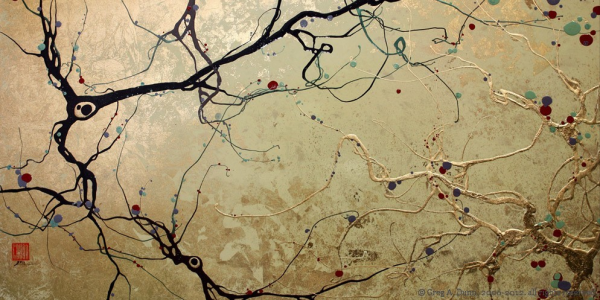
Some NeuroArt (source)

A recent paper from France details the making of a 3D environment that can facilitate 'realistic' neural growth. Labour et al. (2012) created a collagen biomimetic matrix which contains neural growth factor (NGF). 

Labour et al., (2012) Figure 3
These scanning electron microscope images show the porous fibril texture of the collagen matrix. Most of the paper is spent explaining the methods for making this biomimetic matrix, but they also actually grow some pseudo-neurons (PC-12 cells) on the matrix.

They show that when cultured on top of this collagen surface, the cells extend neurons in three dimensions into the matrices and are affected by the NGF. (when there is no NGF, the neurites don't grow and the cells die.)

This paper is mostly about the methods, but I like the new possibilities that growing 3D cells opens up. With these biomimetic collagen matrices, the factors that cause specific dendritic arborizations in three dimensions can be analyzed. The environment can be completely controlled and the neurons easily visualized during growth. The authors suggest using these matrices to study neurodegeneration as well.

Another interesting thing this paper introduced me to is the 'graphical abstract.' I didn't know that that was a thing, but it seems like a good idea. However, trying to summarize an entire paper in one figure seems pretty difficult. Here is their attempt:


Labour et al. (2012) graphical abstract
I think it does actually get the feel of the paper across pretty well, though it's not really informative without the actual abstract next to it.


© TheCellularScale


ResearchBlogging.orgLabour MN, Banc A, Tourrette A, Cunin F, Verdier JM, Devoisselle JM, Marcilhac A, & Belamie E (2012). Thick collagen-based 3D matrices including growth factors to induce neurite outgrowth. Acta biomaterialia, 8 (9), 3302-12 PMID: 22617741
reade more... Résuméabuiyad
Diet Tips to Ease PMS (Premenstrual Syndrome) Symptoms!


(Image credit to Getty Images)


There are a lot of advantages that we can get from a healthy and balanced diet. It can keep you beautiful, maintain your mood, keep the shape of your body (ideal in weight), and keep you active (more energy that you have every day). So what are healthiest and best foods for women of all ages, especially to ease symptoms of PMS? Keep reading!


You might also
reade more... Résuméabuiyad

The ageless face of an Aes Sedai: Science Edition

How would the brain process a truly 'ageless' face?

Moraine, an ageless Aes Sedai (source)
I am sure this question has plagued many Wheel of Time fans, but only now has an experiment been designed to test it. Just 4 days ago, Homola et al. (2012) published a paper in PLoS ONE in which they have people guess ages of people in pictures and scan their brains. 

Homola et al. (2012) Figure 1A. (Which one looks most Aes Sedai to you?)
The first interesting thing that they found was that the older the person in the picture (either a real picture of a real person, or a hybrid 'morphed' picture like the ones above), the harder it was to tell how old they were. This isn't really that surprising, as the range of ages that can 'look' a certain age gets wider over the years.

Homola et al., (2012) Figure 2B.
Here they plot the standard deviation in years for people's guesses as to the age.

The authors showed videos of the faces morphing from one age to another to volunteers while they were in the fMRI machine.

As a side note: they found that there was no difference between male and female volunteers. If they had I think a big deal would have been made about it. but since they didn't it's just a tiny sentence in a long paper.

Ok, back to the processing of age. They threw out the results from people who were really really bad at rating age because they 'weren't motivated' and weren't really trying apparently. (This could be a bit of cherry picking or data massaging) Then they compared the areas of the brain that were active for people who were really really good at guessing age, and people who were only average.


Homola et al., (2012) Figure 4D

The basic finding was that the posterior angular gyrus area (pANG) in the left hemisphere was 5 times more active for the expert age guessers than it was for average. Conclusion: pANG is important for age-processing. This on its own is good to know, but not amazingly interesting. What I think is cool is the idea that the authors present as a  follow up experiment in their discussion:

"Even though our study highlights pANG as one key component for age processing, its precise role in this context is still speculative and needs further investigation. Our model, illustrated in Figure 7, gives rise to interesting hypotheses: One testable prediction would be that disruption of left pANG activity using transcranial magnetic stimulation (TMS), for example, should impair numerical age but not gender judgements, and that brain lesion-symptom mapping can eventually dissociate the two. " Homola et al., (2012)
So now we know, the Aes Sedai must have some magic that transcranially impairs pANG in everyone around them so they can't guess their age. That is how to stay truly ageless.

© TheCellularScale

ResearchBlogging.org
Homola GA, Jbabdi S, Beckmann CF, & Bartsch AJ (2012). A Brain Network Processing the Age of Faces PLoS One DOI: 10.1371
reade more... Résuméabuiyad

You Are Not Alone in this Fight: NAMI PSA

I am loving this short video from NAMI about heroes who lived with depression.

Reminds me of the video I made a few years ago highlighting over 400 high profile people who live with mental illness in my book "Living with Depression."


reade more... Résuméabuiyad

Healthy Sleep Cycle: How to Restore It?


(Image credit to shutterstock)


There are now a lot of factors that can disturb the cycle of your sleep. In this modern living, it’s important to keep your productivity. But sometimes, your tight schedule will put you at high risk of having lack of sleep. This can be the start for your sleep cycle to become irregular. So, how to restore and get back your healthy sleep cycle?

Before
reade more... Résuméabuiyad

Bladder Cancer - More FAQs You Should Know!


(Image credit to ‘Getty Images’)


As the name implies, bladder cancer is a kind of cancerous tumor (abnormal cells) that begins /occurs in the bladder. However, not all cases of this cancer are derived from the original cells of bladder. There are also a type called ‘secondary type’ - it is a cancer from other parts of the body (particularly nearby sites) that spread into bladder. In many
reade more... Résuméabuiyad

Bladder Cancer in Dogs (Symptoms, Causes, Treatment Options)


(Image credit to Getty Images)


Urethra, ureters, kidneys, prostate, and bladder are some important parts of the urinary tract. And cancerous tumor can occur in any of these organs /sites, but in many cases bladder is commonly affected. Invasive transitional cell carcinoma or TCC is the most common type of cancer that affects bladder in dogs.


Before continuing, you might also like to know
reade more... Résuméabuiyad